 Ali Kamaly
LabVIEW Cost in 2026: $500 to $5,000/yr per Seat (Full Breakdown)
The real LabVIEW cost in 2026: subscription tiers, the costs that do not show up on the price sheet, and the cheaper or free paths.
LabVIEW costs roughly $500 per year for Base, $1,800 to $2,500 for Full, and $3,000 to $5,000 for Professional, per seat, on an annual subscription, with a free Community Edition for non-commercial use. If you have tried to find LabVIEW cost on NI's site, you already know the frustration: the real number is behind a quote. This page lays out how the tiers differ, the costs that do not show up on the price sheet, and the cheaper or free paths.
Note up front: NI (now part of Emerson) moved LabVIEW to a subscription model, so the days of a one-time perpetual license are largely over. Prices below are approximate and vary by region, reseller, and volume. Always confirm with a current quote.
LabVIEW subscription tiers and rough pricing
| Edition | Who it is for | Approx. annual price |
|---|---|---|
| Community Edition | Non-commercial, home, makers | Free |
| Base | Simple data acquisition and instrument control | ~$500/year |
| Full | Most professional test and measurement work | ~$1,800 to $2,500/year |
| Professional | Large applications, deployment, advanced tools | ~$3,000 to $5,000/year |
Those are per-seat, per-year figures. A five-engineer lab on Full is looking at roughly $10,000 to $12,000 per year before add-on toolkits.
How to use LabVIEW for free or cheaply
- •Community Edition: Full-featured LabVIEW for non-commercial use. Not licensed for production or commercial work.
- •Student and academic licensing: Heavily discounted or free through universities.
- •Evaluation: NI offers a time-limited free trial.
If your use is commercial, none of these solve the recurring cost. That is why many teams compare LabVIEW against alternatives.
Is LabVIEW worth the price?
If you are deep in NI hardware and your team already knows G, the subscription can be justified. If you are paying mainly to avoid rewriting old code, or you are starting fresh, the math is harder to defend in 2026. Free Python tooling covers a lot of instrument control, and AI-native platforms cover the rest at a lower total cost.
A lower-cost path
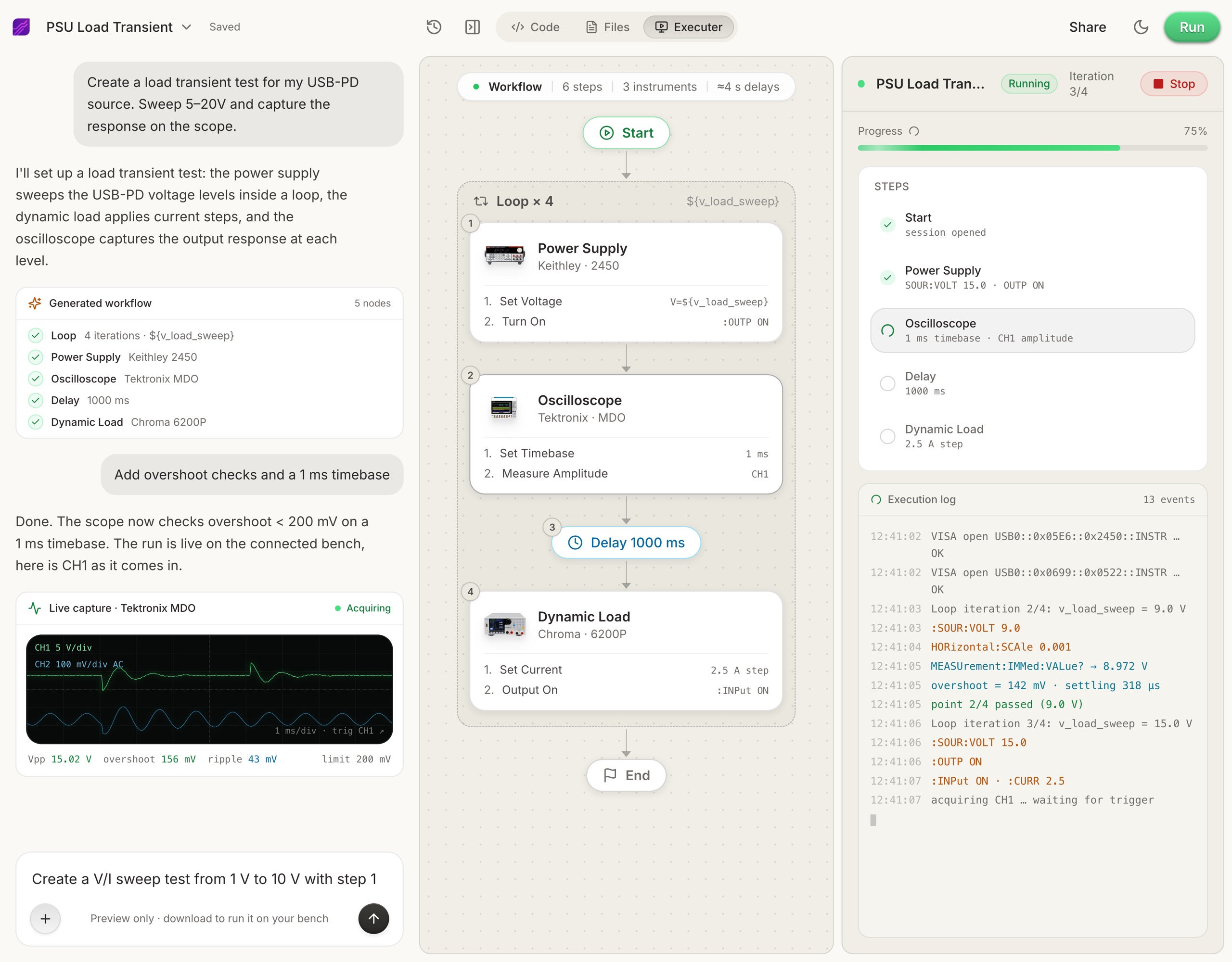
TestFlow is built for engineers who want test automation without the per-seat LabVIEW bill or the NI hardware requirement. For many labs the total cost is a fraction of a comparable LabVIEW plus hardware setup. The whole loop looks like this:
- 1
Connect your instruments. Pick the manufacturer and model, paste the VISA address (USB, LAN, GPIB, or serial), and the agent knows what is on your bench. No bench yet? Use a placeholder address, build the full automation, and swap in the real address when you are in the lab.
- 2
Tell the agent what to test, in plain English. For example, "run a VI sweep from 1 to 10 V in 1 V steps at 0.5 A load current," or "suggest the tests for a power-management device."
- 3
The agent builds the complete workflow in seconds. Instrument-aware automation appears on the canvas, with the generated scripts visible in a code panel you can inspect and edit.
- 4
Run it in your lab. Click Run and the status panel streams results step by step, with measured values inline (VOUT = 3.301 V, asserted 3.2 to 3.4 V, PASS). One click exports a structured PDF report, or the raw results as CSV.
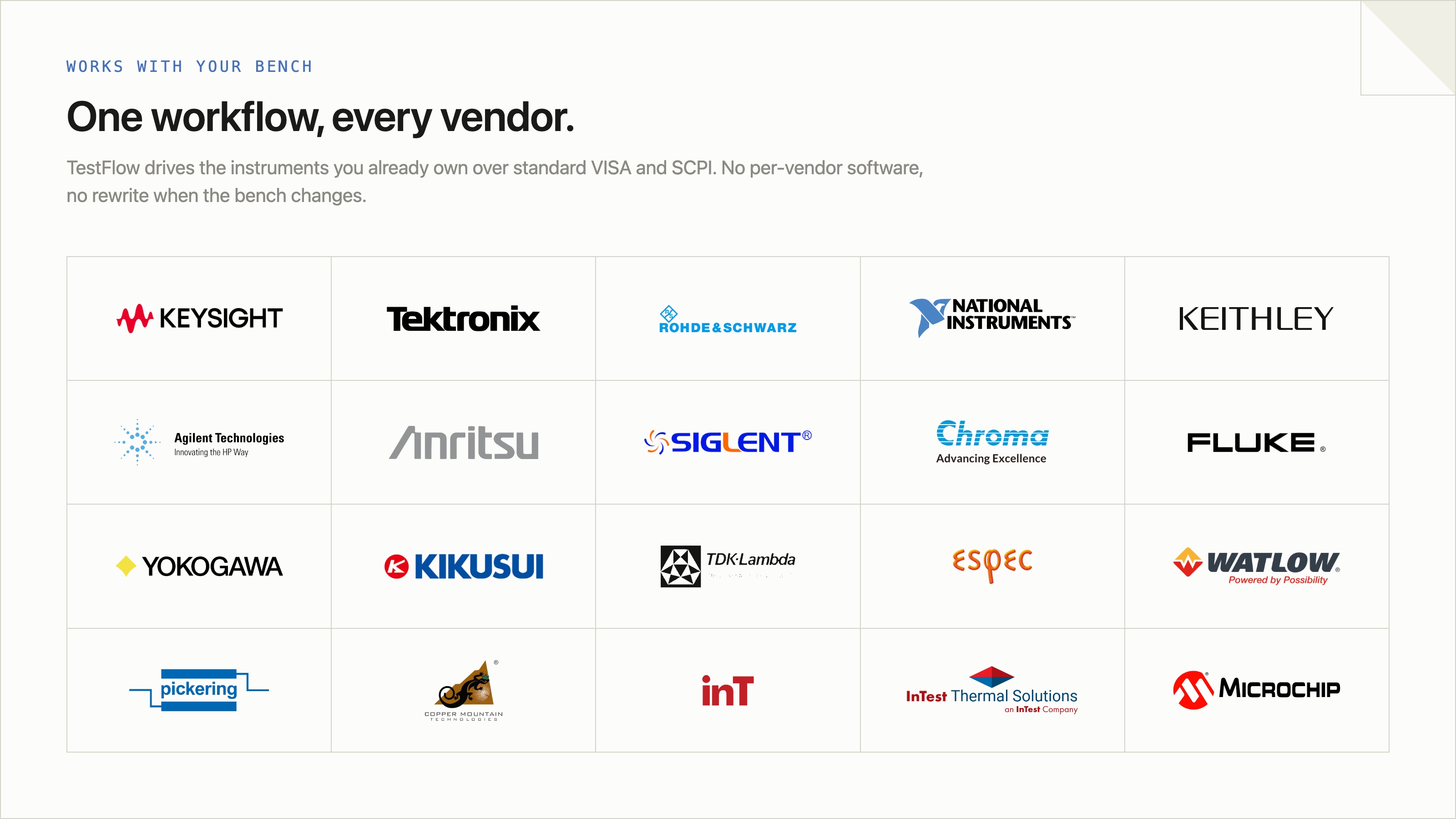
- Vendor-neutral by design. One workflow drives Keysight, Tektronix, Rohde & Schwarz, NI, Rigol, Keithley, Anritsu, and more over standard VISA and SCPI.
- Browser-based and shareable. Workflows live in your workspace, so a sequence built in one lab runs the same way in another.
- Free version to start. Sign in at app.testflowinc.com and build your first workflow today; plans and quotes are on the pricing page.
The step-by-step walkthrough, VISA address formats, and Test Planner prompts are all in the TestFlow product guide.
Frequently asked questions
How much does LabVIEW cost in 2026?
Roughly $500/year for Base, $1,800 to $2,500 for Full, and $3,000 to $5,000 for Professional, per seat, on subscription. Confirm with a quote.
Is LabVIEW free?
The Community Edition is free for non-commercial use. Commercial use requires a paid subscription.
Is LabVIEW a one-time purchase?
No longer, in general. NI moved to annual subscriptions, so budget for a recurring cost.
How much does the LabVIEW plus TestStand stack cost?
Both are licensed separately. On top of the LabVIEW seat, TestStand adds quoted per-seat development licenses and per-station deployment licenses, so a small production line multiplies the annual bill.
Do LabVIEW add-on modules cost extra?
Yes. Modules like FPGA, Real-Time, and Vision are priced separately, and each can cost as much as the base LabVIEW license itself.
Is there a monthly LabVIEW subscription?
NI sells LabVIEW on annual subscription terms. There is no standard month-to-month plan, so plan around the yearly renewal date. If the renewal is the trigger, compare the alternatives a quarter before it lands.
A lower-cost path to automation
No per-seat bill, no NI hardware requirement. Connect your instruments, describe a test in plain English, and run it in minutes.
Tags
Put it on your bench this week
A new way for testing, from specs to automated sequences, capture clean data, and accelerate your validation cycle.