 Ali Kamaly
NI TestStand Alternatives in 2026 (And What TestStand Actually Does)
What TestStand does, how it relates to LabVIEW, what it costs, and the modern, open-source, and AI-native alternatives worth comparing in 2026.

The main NI TestStand alternatives in 2026 are OpenTAP (free, open-source sequencing), pytest or Robot Framework (code-first Python sequencing), and TestFlow (AI-native, builds and runs the sequence from a plain-English request). TestStand itself remains the incumbent on NI-based production lines.
TestStand is National Instruments' test management software, a test sequencer that builds, runs, and manages automated test sequences on a production line or in a validation lab. If LabVIEW is how you write a single measurement, NI TestStand is how you orchestrate hundreds of them into a repeatable test process. This guide explains what it does, what it costs, and when each alternative wins.
What NI TestStand actually does
TestStand software sits above your test code and handles the orchestration that every test station needs:
- •Sequence execution. Define ordered steps, with pass and fail limits, branching, and loops.
- •Calling code modules. Steps call into LabVIEW VIs, C/C++, .NET/C#, or Python.
- •Parallel and batch testing. Test multiple units at once on multi-site stations.
- •Result logging and reporting. Generate reports and log to databases automatically.
- •Operator interfaces and deployment. Ship a controlled UI to production operators.
TestStand and LabVIEW
People often search "teststand and labview" because they are sold together but do different jobs. LabVIEW writes the individual test (read this voltage, set this load). TestStand sequences those tests, manages results, and runs the station. You can use TestStand with LabVIEW, or with C# or Python instead. See the LabVIEW alternatives guide for the other half of the stack, and LabVIEW pricing for what that half costs.
What TestStand costs
Like the rest of the NI (now Emerson) stack, NI TestStand is a separate paid license on top of your test code environment, and the real number sits behind a quote. Budget for three layers:
- •Development seats for every engineer building sequences.
- •Deployment licenses for every station that runs them.
- •The underlying development environment (LabVIEW, C#, or Python tooling) and its own licenses.
For a multi-station line the total adds up quickly, which is why the open-source and AI-native options below get evaluated at renewal time.
The TestStand alternatives, compared
1. OpenTAP (open source)
The closest open-source equivalent. OpenTAP, started at Keysight, gives you test plans, steps, result listeners, and a plugin architecture in C# with Python support. Free and actively maintained. The tradeoff: it is a framework, not a finished station. You write the instrument steps, and the polished GUI editor belongs to Keysight's commercial PathWave layer on top.
2. pytest + custom harness (open source)
If your team codes in Python, pytest's fixtures, parametrization, and plugin ecosystem map surprisingly well onto test sequencing: fixtures manage instrument setup, parametrize sweeps the test matrix, and plugins handle HTML or database reporting. Everything lives in Git. The tradeoff is that operator UIs, limit management, and multi-UUT parallelism are yours to build.
3. Robot Framework (open source)
A keyword-driven automation framework with readable, table-style test cases that non-programmers can follow. Hardware teams use it with custom Python keyword libraries for instrument control. Strong reporting out of the box. The tradeoff: you still write the instrument keywords, and heavy measurement logic ends up in Python anyway.
4. TestFlow (AI-native)
TestFlow approaches sequencing from the other direction: instead of hand-building each step, you connect your instruments, describe the validation flow in plain English, and the agent generates the structured, repeatable workflow and runs it. Vendor-neutral by design, browser-based, with a free version to start.
| Option | Type | Cost | Best for |
|---|---|---|---|
| OpenTAP | Open source | Free | Replacing TestStand sequencing with open source |
| pytest harness | Open source | Free | Python-fluent teams who live in Git |
| Robot Framework | Open source | Free | Readable test cases, mixed-skill teams |
| NI TestStand | Commercial | Quoted, per seat + station | Established NI production lines |
| TestFlow | AI-native | Free version to start | Validation flows from a plain-English request |
When staying on TestStand is the right call
Honesty matters in this comparison: if you run a regulated, multi-site production line with years of TestStand sequences, trained operators, and NI PXI hardware, migrating mid-product is rarely worth it. The alternatives win at three moments: a new line or new lab being stood up, a renewal quote that jumped, or a validation team (rather than production test) that needs sequencing discipline without production-line infrastructure. For that last case, see how structured test coverage works in practice.
Where TestFlow fits
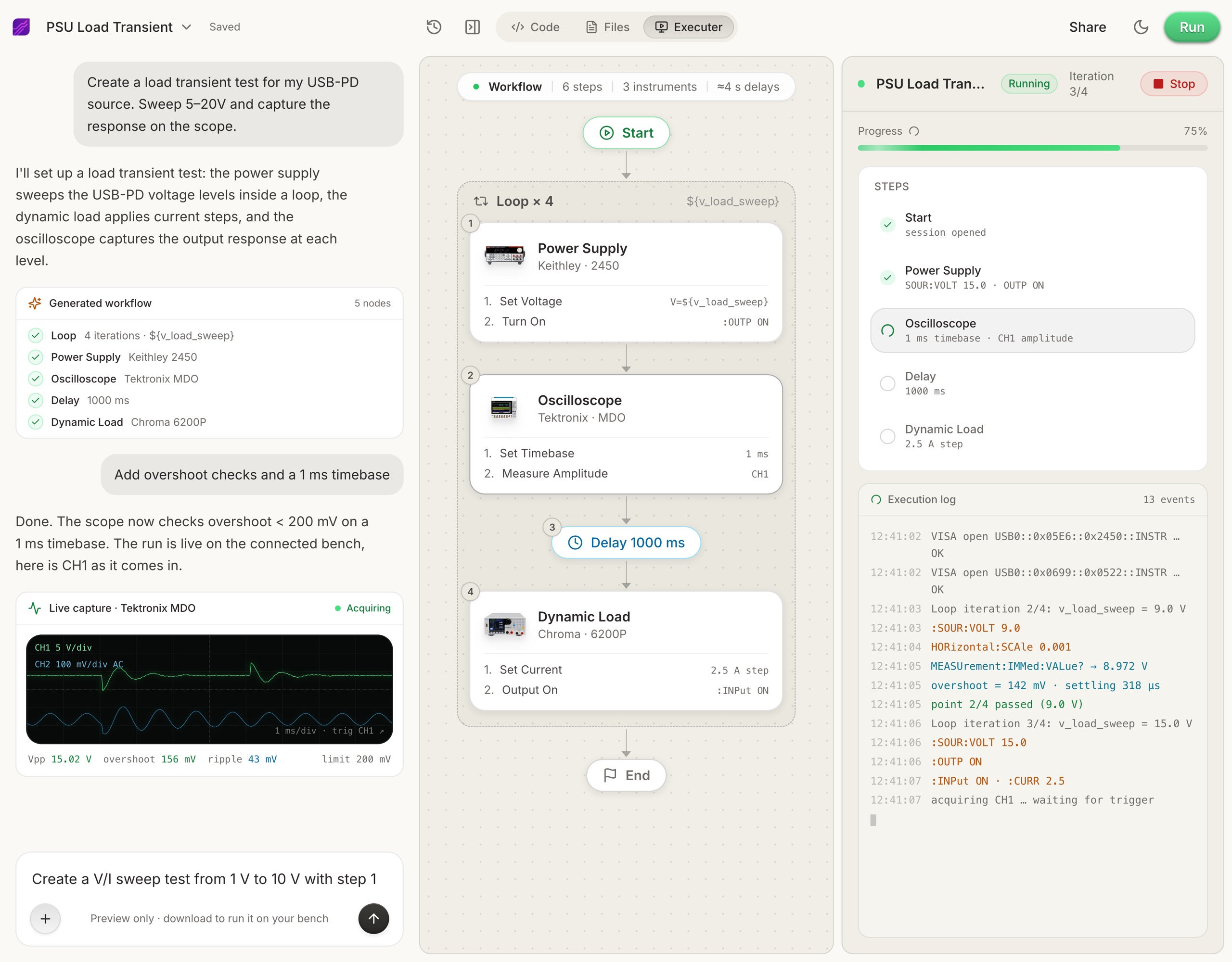
TestStand's core idea, structured and repeatable test sequences, is exactly what TestFlow's workflow automation engine provides, but AI-native and without the NI ecosystem. Instead of hand-building each sequence, you drive the bench with an AI agent:
- 1
Connect your instruments. Pick the manufacturer and model, paste the VISA address (USB, LAN, GPIB, or serial), and the agent knows what is on your bench. No bench yet? Use a placeholder address, build the full automation, and swap in the real address when you are in the lab.
- 2
Tell the agent what to test, in plain English. For example, "run a VI sweep from 1 to 10 V in 1 V steps at 0.5 A load current," or "suggest the tests for a power-management device."
- 3
The agent builds the complete workflow in seconds. Instrument-aware automation appears on the canvas, with the generated scripts visible in a code panel you can inspect and edit.
- 4
Run it in your lab. Click Run and the status panel streams results step by step, with measured values inline (VOUT = 3.301 V, asserted 3.2 to 3.4 V, PASS). One click exports a structured PDF report, or the raw results as CSV.
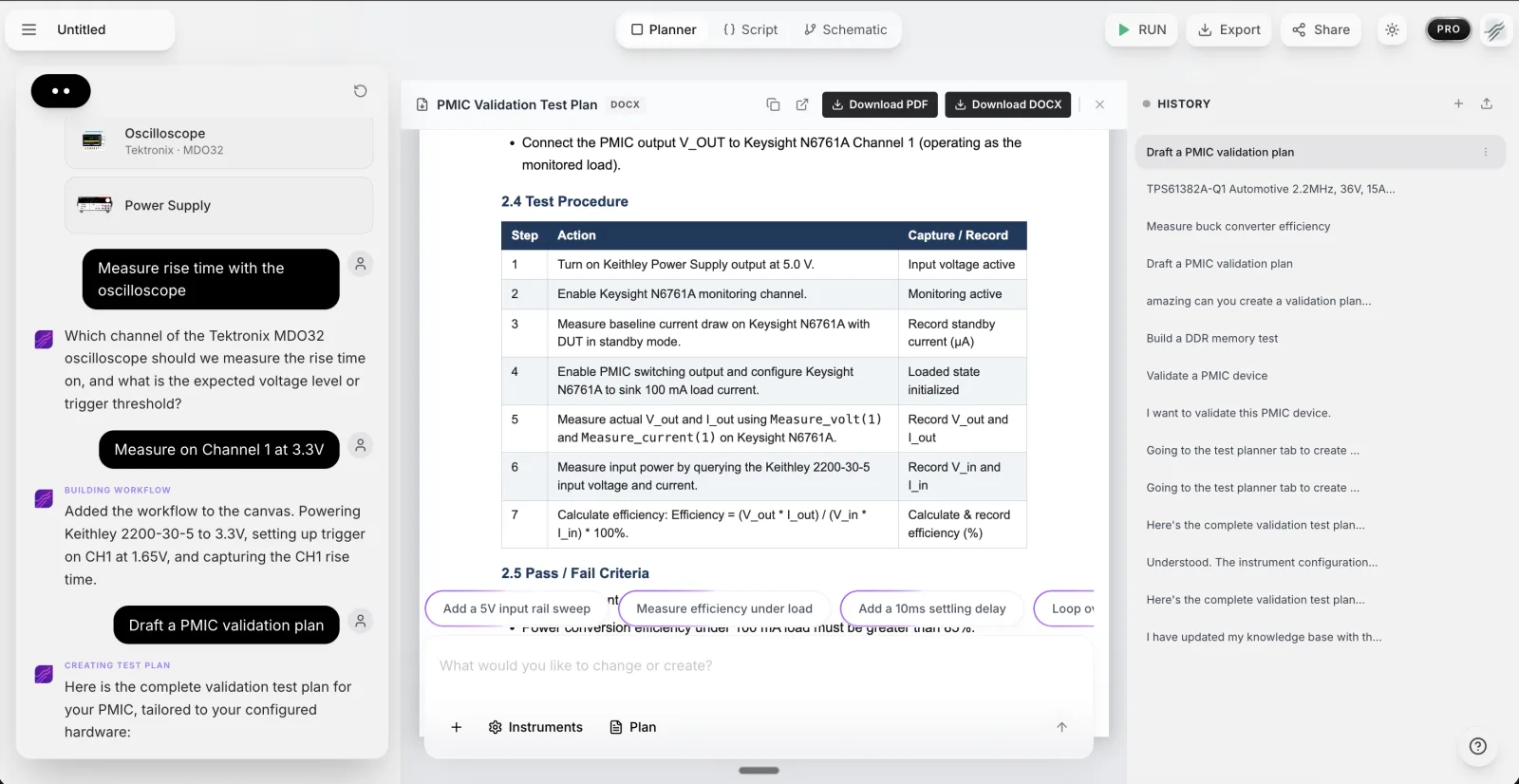
For bigger jobs there is the Test Planner: describe the device and conditions, and it drafts a structured validation plan, numbered test cases with purpose and setup, a measurement matrix with units and thresholds, and explicit pass/fail criteria. You review it, export it as PDF or DOCX, then tell the agent to build the workflow from the approved plan.
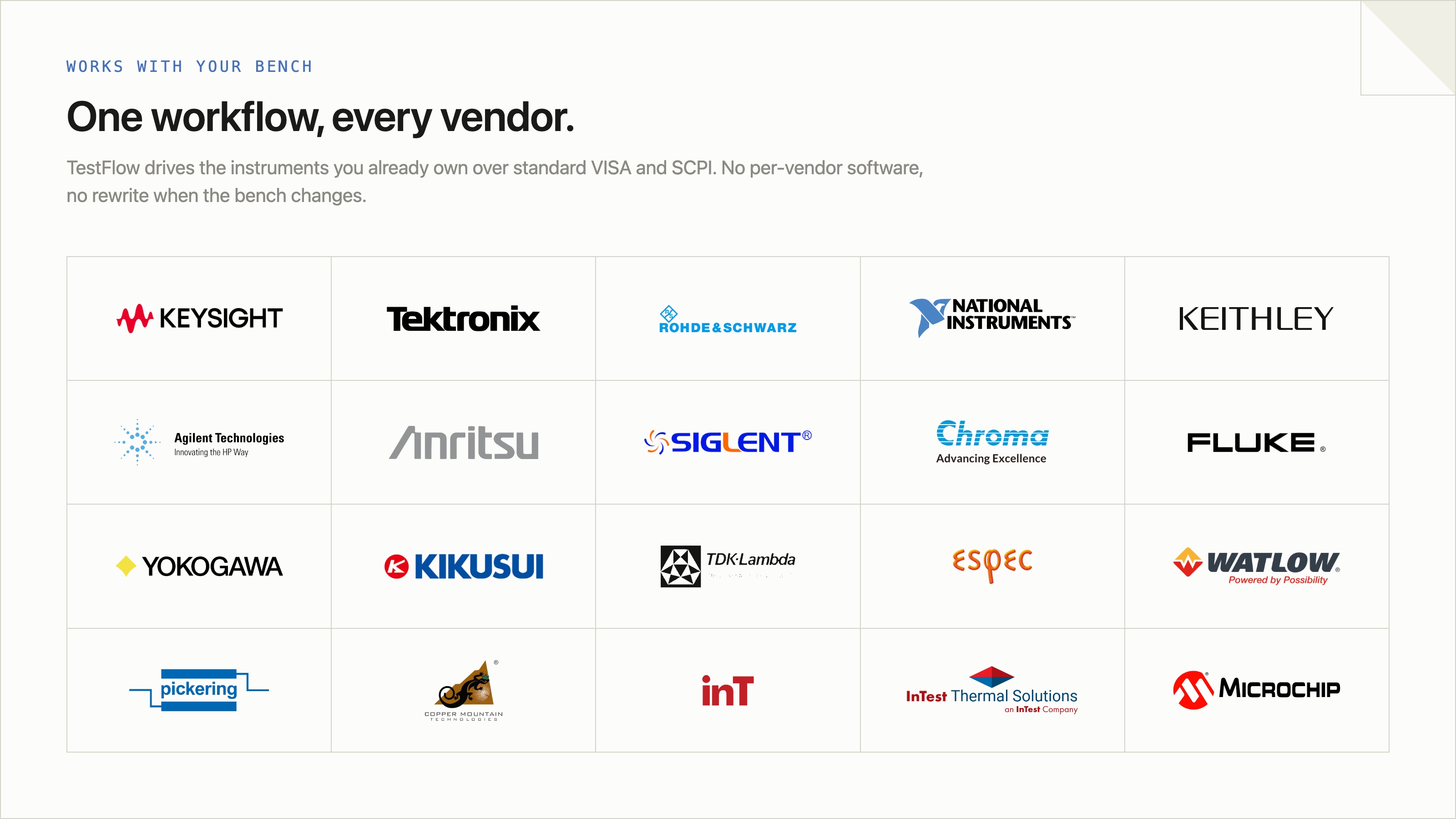
- Vendor-neutral by design. One workflow drives Keysight, Tektronix, Rohde & Schwarz, NI, Rigol, Keithley, Anritsu, and more over standard VISA and SCPI.
- Browser-based and shareable. Workflows live in your workspace, so a sequence built in one lab runs the same way in another.
- Free version to start. Sign in at app.testflowinc.com and build your first workflow today; plans and quotes are on the pricing page.
The step-by-step walkthrough, VISA address formats, and Test Planner prompts are all in the TestFlow product guide.
For teams that want TestStand's discipline without its cost and lock-in, it is a direct comparison worth making. There is a free version to start.
Frequently asked questions
What is NI TestStand used for?
Building, running, and managing automated test sequences, with result logging, reporting, and operator interfaces, mainly in manufacturing test and validation.
Is TestStand the same as LabVIEW?
No. LabVIEW writes individual tests; TestStand sequences and manages them. They are often used together.
Is there a free TestStand alternative?
Yes. OpenTAP is a free, open-source test sequencer, pytest and Robot Framework can fill the role for code-first teams, and TestFlow has a free version that builds and runs the flow for you.
Does TestStand require LabVIEW?
No. TestStand steps can call LabVIEW VIs, C/C++, .NET/C#, or Python modules. In practice most deployments pair it with LabVIEW.
Is NI TestStand free?
No. TestStand is a commercial product with paid development seats and deployment licenses per test station. NI offers a time-limited evaluation.
What is the open-source alternative to TestStand?
OpenTAP, the open-source test automation framework started at Keysight, is the closest open-source equivalent for sequencing, with plugins and result listeners.
TestStand discipline, without the lock-in
Connect your instruments, describe the sequence in plain English, and TestFlow builds and runs the validation flow in minutes.
Tags
Put it on your bench this week
A new way for testing, from specs to automated sequences, capture clean data, and accelerate your validation cycle.